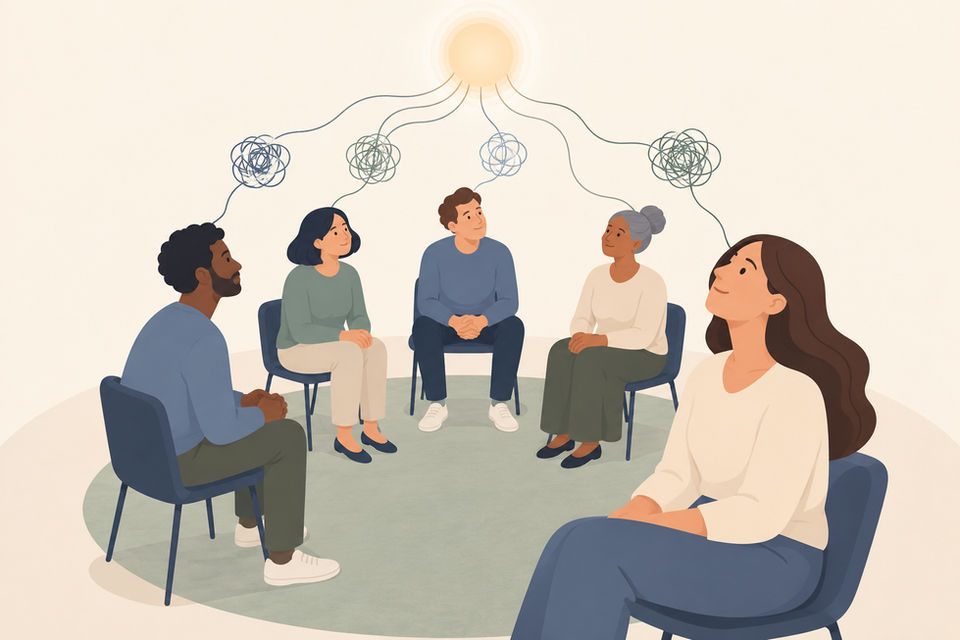
When Does Group Therapy Help With Psychological Strain?

Maybe you know this thought: "My issues are very personal. Can a group really be the right place for them?" This hesitation is understandable. At the same time, many people experience something surprising once they engage with the protected setting: they are not alone with their thoughts, feelings and challenges. So when does group therapy help most? When sharing, new perspectives and trying things out in practice can meaningfully add to the therapeutic process.
Group therapy does not mean you have to reveal private matters to lots of strangers. It is a clearly structured form of psychotherapy with fixed rules, therapeutic leadership and a shared focus. Especially for people who carry a lot of responsibility at work, are under high pressure or often adapt to others in daily life, it can be a place where new experiences become possible.
When group therapy helps most
A group can be helpful when psychological strain also shows up in contact with other people. This includes, for example, self-doubt, social anxiety, conflict, difficulties with closeness or setting boundaries, depression and ADHD. Many patterns do not arise in a vacuum. They show up in conversations, in teams, relationships and families, or in moments when expectations collide.
In group therapy, these situations are not only talked about. In a protected setting they can be understood and, step by step, experienced differently. If you fear you are not good enough, you may find that other people listen closely, give feedback and can understand your perspective. If you usually back off quickly, you can practice stating what you need clearly. These concrete experiences often have a more lasting effect than insight alone.
Group therapy can be especially suitable if you often feel isolated or think you "really should be coping better" with your difficulties. High-achieving people in particular hide overwhelm for a long time. On the outside they function; inside, thoughts keep circling, concentration drops or dealing with others becomes more tiring. Experiencing that others know similar inner struggles can bring relief and reduce shame.
A group can also be stabilizing during changes at work. Layoffs, reorganizations, new leadership structures or long-term uncertainty about the future unsettle even very experienced professionals and managers. The group gives you room to make sense of the strain, notice your own room for action again and recharge for the next steps.
How group therapy works
The effect does not come from the therapist alone. It also comes from the encounters between participants. In a carefully put-together group, people with different life stories meet who often know similar themes. This makes patterns visible that sometimes stay more in the background in one-to-one sessions.
A key factor is resonance. Maybe someone describes a situation from work that you have experienced yourself in a different form: the feeling of being too slow, giving too much weight to a piece of feedback, or feeling blocked inside before an important appointment. Suddenly your own experience has words. That can give orientation and make you look at yourself more kindly.
Honest, respectful feedback is just as valuable. Other group members may notice what you overlook yourself: your strength, your clarity, but also your tendency to make yourself small or take responsibility for everything. This feedback is not a judgment. It helps you develop new perspectives and better understand how you come across.
Group therapy based on behavioral therapy is also very concrete. Depending on the topic, it may be about examining stressful thoughts, understanding feelings better, building helpful routines or preparing for social situations. Between sessions, small, realistic exercises can help carry changes into daily life. The goal is not perfection, but more self-efficacy.
Group therapy for ADHD
For adults with ADHD, a group can be especially valuable. Many people with ADHD know the huge inner effort behind a daily life that looks successful from the outside. Appointments, priorities, interruptions, emotional reactions and procrastination cost energy. Often there is also the experience of being seen again and again as disorganized, too sensitive or not consistent enough.
An ADHD group is not about optimizing yourself even further. It is about understanding your own patterns and developing strategies that fit. These include, for example, dealing with sensory overload, planning, focus, impulsivity, self-esteem and communication. Sharing with others can help you find solutions that are realistic and fit your own life. What works for one person does not have to be right for everyone. This very variety can be a relief.
The atmosphere in the group matters too. When people experience that their difficulties make sense to others, and that they do not constantly have to explain why something takes so much energy, more trust in their own abilities often grows. That is why ADHD group therapy at Psymondo in Munich takes place in a clear, professionally guided setting.
When individual therapy may be the better choice
Group therapy is effective, but it is not the first or only suitable step in every situation. In an acute mental health crisis, with strong suicidal thoughts, marked instability, or when a very protected one-to-one setting is needed first, individual therapy can make more sense. There, pace, depth and approach can be tailored even more individually.
If you are having suicidal thoughts right now, please get help immediately: call the emergency number 112, the Krisendienst Psychiatrie Bayern (Bavarian psychiatric crisis service) at 0800 655 3000 (24/7), or the TelefonSeelsorge helpline at 0800 111 0 111.
Traumatic experiences, intense shame or worry about being visible can also speak against a group at first. That is not a sign of unwillingness. Safety is the foundation of any therapy. Sometimes it helps to build trust in one-to-one sessions first and later check whether a group could be a good addition.
Some people would like a combination. Individual therapy offers room for very personal topics and an individual diagnostic assessment. The group adds the chance to try out new behavior with others. Which format makes sense depends on your concerns, your current level of strain and your goals.
What you should know before you start
Good group therapy needs a reliable framework. This includes confidentiality, respectful interaction and a clear agreement not to share what is said in the group with anyone outside it. Nobody has to share more than they can right now. At the same time, the group lives from participants being willing to bring in their experiences and to meet others with attention.
It is normal to feel nervous before the first session. Many people wonder whether they will fit into the group, whether they will say enough, or whether they might open up too much. These questions are allowed. An initial conversation can clarify which offer suits your situation, what your goals are and what helps you feel safe.
The composition of the group matters too. Groups that are matched by topic and professionally led create a different setting than casual sharing. The therapist makes sure everyone gets a chance to speak, boundaries are respected and the shared work stays structured.
The first step can be small
You do not have to decide right away whether group therapy is the right path for the coming months. Clarity often begins with a first conversation and the honest question: What do I really want right now? More understanding for myself, concrete strategies, relief in contact with others, or a place where I do not have to carry everything alone?
If you are ready to open up to new experiences in a protected setting, group therapy can set a lot in motion. Not because others solve your problems for you, but because you can experience, with inner strength, trust and more clarity: change is possible, and you do not have to walk this path alone.
Quick answers
Who is group therapy suitable for?
It can help when psychological strain also shows up in contact with others, for example with self-doubt, social anxiety, conflict, difficulties with closeness or boundaries, depression and ADHD. It can also be stabilizing during changes at work.
When is individual therapy the better choice?
In an acute crisis, with strong suicidal thoughts, marked instability, or when a very protected one-to-one setting is needed first. Traumatic experiences or intense shame can also speak for starting individually.
Do I have to share a lot in a therapy group?
No. Nobody has to share more than they can right now. Confidentiality and respectful interaction are part of the agreed framework, and the therapist makes sure boundaries are respected.