Online Psychotherapy: Making Good Use of Video Sessions
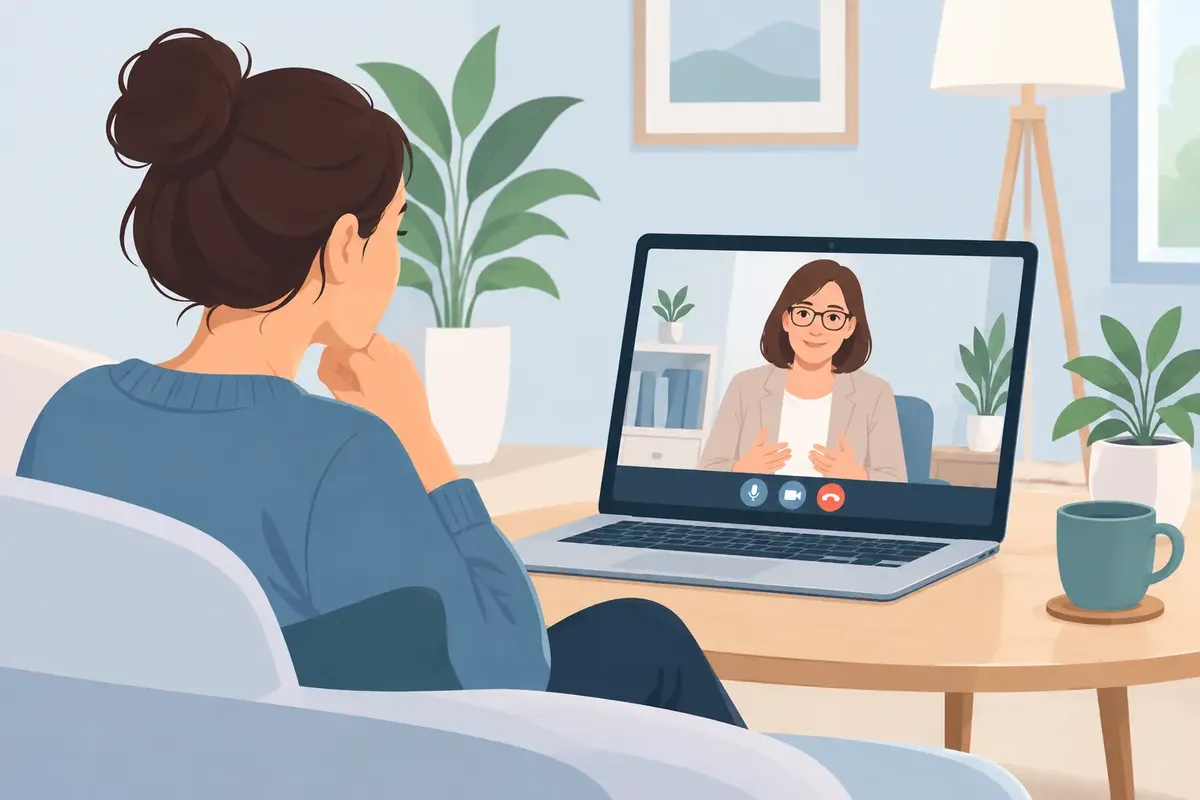
A difficult morning, a tightly packed workday or the worry of being seen on the way to the practice: sometimes it is the practical hurdles that make support seem unnecessarily far away. Online psychotherapy by video session creates a protected setting in which you can work on your concerns from a familiar place. It does not automatically replace every in-person session, but it can be a professionally sound, personal and effective form of psychotherapeutic support.
Especially for working people, people with a lot of responsibility or those who travel a lot for work, this means more than saving time. It can make regular sessions easier, anchor therapy in everyday life and create room for change. What matters is not the technology, but the therapeutic relationship, a clear treatment framework and whether this format fits your current situation.
Who is online psychotherapy by video suitable for?
A video session can be helpful for many kinds of mental health strain, for example depression, anxiety disorders, obsessive thoughts and compulsive behaviors, phobias, self-esteem problems or feeling overwhelmed. With ADHD, too, it can be a good addition when the goal is to structure daily life better, build helpful strategies and make behavior patterns understandable. In behavioral therapy, we work together on concrete questions: Which situations trigger the strain? Which thoughts, feelings and reactions keep it going? And what is a realistic next step?
The online format is a particularly good fit if you have an undisturbed place, can attend reliably, and are generally able to talk personally through a screen. Many people even find their familiar surroundings a relief. You do not have to travel across town after an emotional conversation. Instead, you can take time to let it sink in, go for a short walk or put a small exercise into practice right away.
Whether we work online, at the practice in Munich or alternating between both depends on your concerns. Some topics benefit from experiencing the therapeutic work together in the same room. For others, digital support fits especially well into everyday life. A good decision is made in the initial consultation, not from a rigid either-or.
What stays the same in therapy by video
Psychotherapy does not become less personal just because it takes place online. The session has a fixed appointment, a clear length and a confidential setting. You describe what weighs on you, and together we make sense of connections, develop goals and plan concrete steps. Feelings, uncertainty, pauses or resistance also have their place. You do not have to appear especially composed, eloquent or prepared in front of the camera.
In behavioral therapy, the focus is not only on talking about problems. It is also about widening your options for action. Maybe you practice checking distressing thoughts, finding a way to deal with avoidance, breaking tasks with ADHD into small steps or communicating boundaries at work more clearly. Between sessions, observation tasks and exercises can help so that new experiences do not remain theory.
The quality of therapy is not measured by how quickly you feel better. Change rarely happens in a straight line. Sometimes you first need more clarity about what exhausts you, hurts you or drives you inside. In a protected setting, this process may take its own pace, with a therapist who supports you with professional clarity and human warmth.
Technology and privacy: what you can prepare yourself
You do not need a perfect workspace for a good video session. What matters is a stable internet connection, a device with a camera and microphone, and headphones if other people are nearby. Choose a room where you will not be interrupted and can speak freely. That can be a study, a quiet room at home or, in exceptional cases, a confidential place during a business trip.
Avoid taking notes the whole time if it makes you lose contact. It is often more helpful to jot down a few keywords: What was especially important today? Which thought do you want to take with you into the week? What would you like to try? If you live with others, a simple sentence can help: "I'm in a confidential appointment and don't want to be disturbed."
A professional video session takes place via a suitable, data-protection-compliant platform. Also remember to turn off notifications on your smartphone and computer. Privacy comes not only from technology, but also from the conscious decision to truly reserve this time for yourself.
When an in-person session can make more sense
Video sessions have limits. If you are in an acute crisis, might harm yourself or others, or urgently need immediate help, an online session is not the right place to be your only safety net. In such moments, please contact the emergency number 112, a psychiatric emergency department, a crisis service (in Bavaria, the Krisendienst Psychiatrie at 0800 655 3000) or a trusted person near you. Help should then be fast, concrete and on site.
An in-person session can also be the better choice if your home situation does not allow confidentiality. That applies, for example, to living together with a lot of conflict, having no place to retreat to, or feeling persistently inhibited in front of the screen. Honest feedback is valuable here: if something does not work well online, we do not stick to it just because it was convenient to plan.
Some clients choose a mixed format. They use video sessions in busy work weeks and come to the practice for selected appointments. This keeps continuity and personal contact connected. At Psymondo, we can look together at which setting reliably supports your treatment.
Telling psychotherapy and coaching apart
Online conversations can be therapeutic or coaching-based, but the goals are different. Psychotherapy addresses mental health problems of clinical significance and follows a diagnostic and therapeutic mandate. It can be indicated when anxiety, depressive symptoms, compulsions, ADHD-related difficulties or other strain clearly restrict your daily life, your relationships or your ability to work.
Coaching, by contrast, is oriented toward solutions and development. It can help you, for example, to notice stress earlier, set clearer priorities, prepare decisions or communicate with more confidence. Achievement-oriented people in particular sometimes overlook how long they have been going beyond their limits. Coaching can then help you regain your ability to act. If there is clinical significance, however, what you need is a psychotherapeutic assessment and treatment rather than just optimizing performance.
How to get more out of your appointment
You do not have to come to the session with a finished agenda. Still, it can help to pause briefly beforehand: What is on my mind most right now? Where did I get stuck this week? What would be a small, noticeable change? Questions like these give orientation without you having to sort out your feelings before you are allowed to talk about them.
If possible, plan ten minutes before and after the appointment. Beforehand, you can arrive and check the technology. Afterwards, there is room to let the conversation settle instead of switching straight into the next meeting. If an exercise or agreement from the session becomes difficult in everyday life, that is not a failure. It often holds important clues about what you need and which hurdle deserves a closer look.
Support that fits your life
The right place for therapy is the place where you can open up and keep working on your goals. For some, that is the practice. For others, it is a quiet corner at home, and for many, a sensible combination of both. What matters is that you do not have to struggle through difficult times alone just because your days are tightly scheduled.
A video session can give you the chance to pause, gain clarity and stop putting off new steps. You are allowed to shape support so that it stays within reach. With inner strength, trust and a reliable counterpart, change can begin right where you are.
Quick answers
What do I need for an online psychotherapy video session?
A stable internet connection, a device with a camera and microphone, headphones if others are nearby, and a room where you can talk freely without being interrupted.
What can online psychotherapy help with?
For example depression, anxiety disorders, obsessive thoughts and compulsions, phobias, self-esteem problems, feeling overwhelmed, and as support for structuring daily life with ADHD.
When is an in-person session the better choice?
In acute crises you need immediate help on site. An in-person session can also be better if you have no confidential space at home or feel inhibited in front of the screen. A mix of video and practice sessions is possible.